Plain Decoder
We now have all pages for a single column chunk. However, all of them are encoded. In this step, we will decode page data and extract the actual column values. Let’s start with the simplest one: Plain encoding.
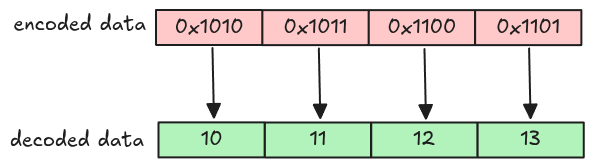
Plain Encoding
In plain encoding, each value is encoded separately depending on the column data type. For our parser, only these data types are supported (the explanations are taken from the spec).
| Data type | Parquet type | Explanation |
|---|---|---|
| BOOLEAN | BOOLEAN | Bit packed, LSB first |
| INT32 | INT32 | 4 bytes little endian |
| INT64 | INT64 | 8 bytes little endian |
| FLOAT | FLOAT | 4 bytes IEEE little endian |
| DOUBLE | DOUBLE | 8 bytes IEEE little endian |
| STRING | BYTE_ARRAY | length in 4 bytes little endian followed by the bytes contained in the array |
To represent a decoded value in code, we use
Polars Scalar. This makes the
implementation much simpler as we don’t have to deal with type erasure, type casting, etc. A
Scalar can be created like this.
let scalar_integer = Scalar::from(1i32);
let scalar_string = Scalar::from(PlSmallStr::from_string("one"))
Task
plain_decode
Implement the plain_decode function in src/decoder/plain.rs. It takes the encoded page data as
Bytes and returns a decoded vector of Scalar based on the data type. The num_values is the
expected value for the vector.
pub fn plain_decode(
    encoded_data: Bytes,
    parquet_type: Type,
    num_values: usize,
) -> Result<Vec<Scalar>> {
    match parquet_type {
        Type::INT32 => todo!("step05: decode int32"),
        Type::INT64 => todo!("step05: decode int64"),
        Type::FLOAT => todo!("step05: decode float"),
        Type::DOUBLE => todo!("step05: decode double"),
        Type::BYTE_ARRAY => todo!("step05: decode string"),
        Type::BOOLEAN => todo!("step09: decode boolean"),
        _ => unimplemented!("plain_decode: unsupported data type {:?}", parquet_type),
    }
}
Some important notes:
-
You don’t have to handle
BOOLEANdata yet, it requires different encoding, which will be covered in Boolean Data section -
To avoid messing with unicode data, we assume all
BYTE_ARRAYdata can be converted toStringwithout error. In other words, this never panicsString::from_utf8(data).unwrap()
decode_page
Implement the decode_page function insrc/decoder/mod.rs. This is a wrapper around all supported
decoders, it checks the page’s encoding and applies the correct decoder. You need to handle the
Encoding::PLAIN arm in this step.
pub fn decode_page(page: &Page, parquet_type: Type, num_values: usize) -> Result<Vec<Scalar>> {
    match page.encoding() {
        Encoding::PLAIN => todo!("step05: plain decoder"),
        // ...
    }
}
You can get the encoded page data using Page::encoded_values().
Test
Test case for this step is step05_plain_decoder.
Hints and Solution
Hint (how to decode non-string types)
Some functions from the bytes crate docs are useful
to extract primitive types. The extracted value can be converted to Scalar using Scalar::from.
For example, this decodes the INT32 data.
let scalar = Scalar::from(data.get_i32_le());Hint (how to decode string type)
String uses a variable length, the first 4 bytes is the length followed by the actual string value.
let length = data.get_u32_le() as usize;
let string = data.slice(..length)
The actual bytes value can then be converted to String using String::from_utf8 and
PlSmallStr::from_string.
let string = String::from_utf8(data).unwrap();
Scalar::from(PlSmallStr::from_string(string))
Solution
plain_decode:
pub fn plain_decode(
    encoded_data: Bytes,
    parquet_type: Type,
    num_values: usize,
) -> Result<Vec<Scalar>> {
    let mut encoded_data = encoded_data;
    let mut scalars = Vec::with_capacity(num_values);

    match parquet_type {
        Type::INT32 => {
            for _ in 0..num_values {
                scalars.push(Scalar::from(encoded_data.get_i32_le()))
            }
        }
        Type::INT64 => {
            for _ in 0..num_values {
                scalars.push(Scalar::from(encoded_data.get_i64_le()))
            }
        }
        Type::FLOAT => {
            for _ in 0..num_values {
                scalars.push(Scalar::from(encoded_data.get_f32_le()))
            }
        }
        Type::DOUBLE => {
            for _ in 0..num_values {
                scalars.push(Scalar::from(encoded_data.get_f64_le()))
            }
        }
        Type::BYTE_ARRAY => {
            for _ in 0..num_values {
                let size = encoded_data.get_u32_le() as usize;
                let string = String::from_utf8(encoded_data.split_to(size).to_vec())?;
                scalars.push(Scalar::from(PlSmallStr::from_string(string)))
            }
        }
        Type::BOOLEAN => todo!("step09: decode boolean"),
        _ => unimplemented!("plain_decode: unsupported data type {:?}", parquet_type),
    }

    Ok(scalars)
}decode_page:
pub fn decode_page(page: &Page, parquet_type: Type, num_values: usize) -> Result<Vec<Scalar>> {
    match page.encoding() {
        Encoding::PLAIN => plain_decode(page.encoded_values(), parquet_type, num_values),
        // ...
    }
}