Boolean data
This section will handle the boolean data type. Recall from the Plain Decoder section, boolean data type is encoded using bit-packed encoding.
| Data type | Parquet type | Explanation |
|---|---|---|
| BOOLEAN | BOOLEAN | Bit packed, LSB first |
Bit-packed encoding
Bit-packed encoding encodes each value into bits (using the same bit-width), then packs them together (hence the name bit-packed). Below is an example of encoding 10, 20, 30, 40 using 6-bit width.
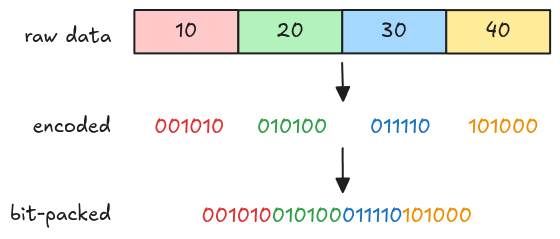
The figure above just gives you a rough idea of how bit-packed works in general, it isn’t exactly what parquet bit-packed encoding does, we will look into this later in Bit-packed arbitrary bit-width.
Parquet bit-packed encoding for boolean data
For boolean data, each value can be either true or false, so 1-bit width is sufficient. Encoding
and decoding using 1-bit width is much easier than arbitrary bit-width because there are no values
crossing byte boundaries.
Encode
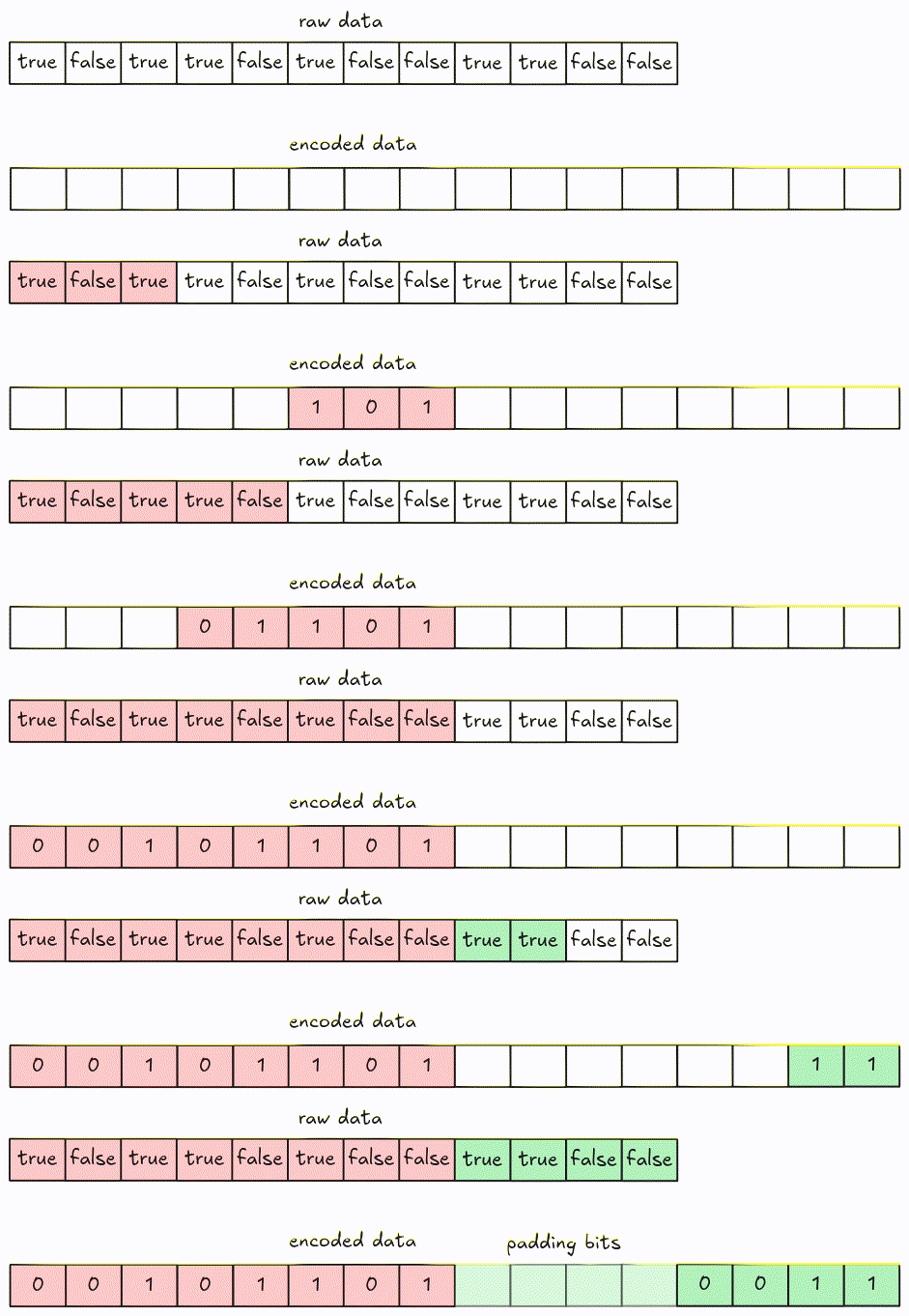
For encoding, values are packed together into 8-bit groups using LSB (Least Significant Bit) first. Groups with fewer than 8 bits are padded with 0.
Decode
Decoding can be performed by fetching every 8-bit group at a time, then shifting bits until there is no remaining data left (or if we get enough values).
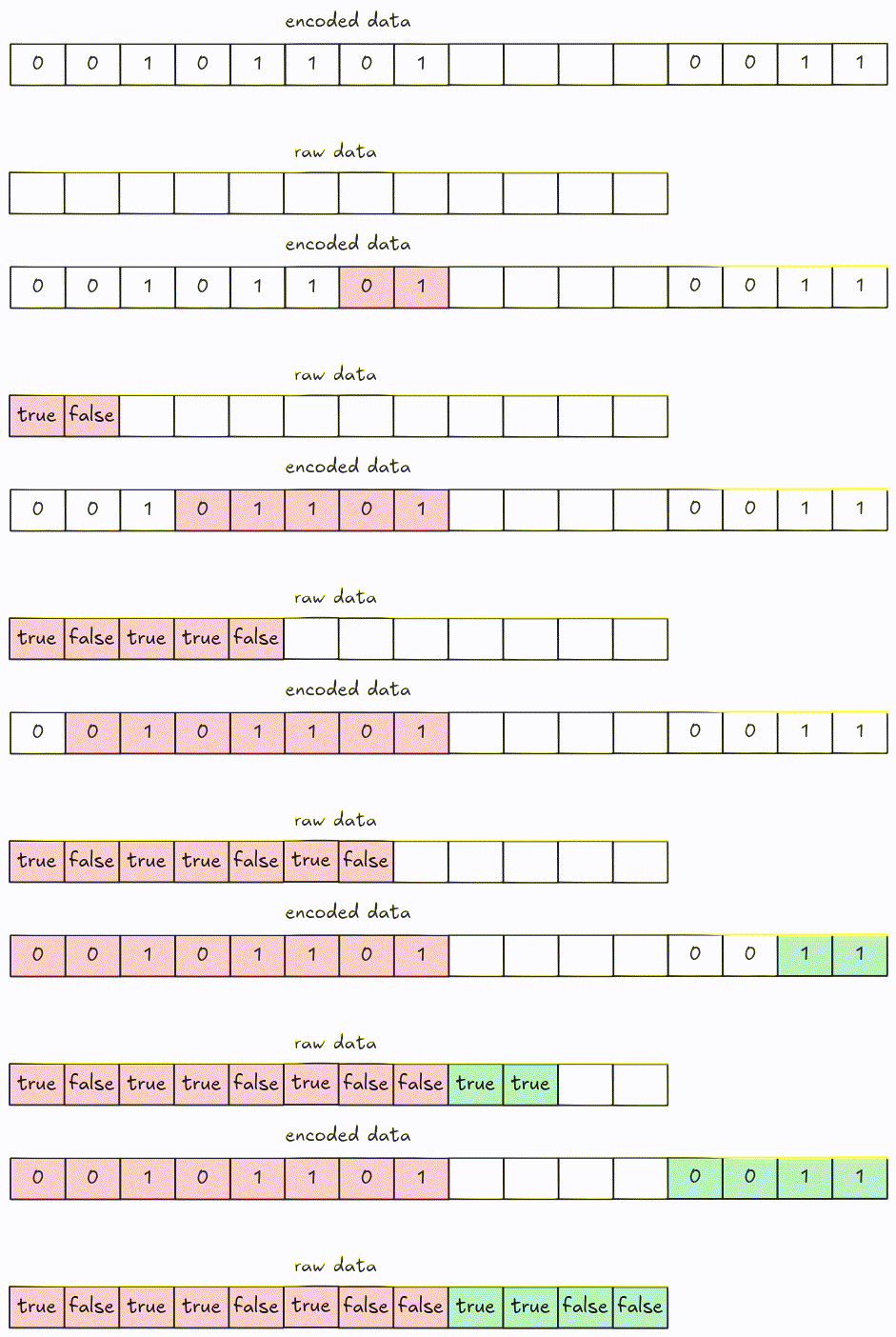
You can optimize decoding by fetching more than 8 bits at a time (i.e. 32 bits).
Task
bit_packed_decode
Implement the bit_packed_decode function in src/decoder/bit_packed.rs. It takes the encoded page
data as Bytes and returns a decoded vector of Scalar.
pub fn bit_packed_decode(
    encoded_data: Bytes,
    parquet_type: Type,
    bit_width: u8,
    num_values: usize,
) -> Result<Vec<Scalar>> {
    todo!("step09: implement the boolean data decoder")
}
For boolean data, the bit-width is always 1.
plain_decode
Update the plain_decode in src/decoder/plain.rs function to handle boolean data type.
pub fn plain_decode(
    encoded_data: Bytes,
    parquet_type: Type,
    num_values: usize,
) -> Result<Vec<Scalar>> {
    match parquet_type {
        // ...
        Type::BOOLEAN => todo!("step09: decode boolean"),
        // ...
    }
}
Test
Test case for this step is step09_boolean_column.
Hints and Solution
Hint (decoding steps)
- Fetch the data each 8 bits at a time. (You can optimize by reading 4 bytes at a time in little endian).
- Shift right until there are no bits left or until you get enough values.
- Create vector of boolean
Scalar.
Solution
bit_packed_decode:
pub fn bit_packed_decode(
    encoded_data: Bytes,
    parquet_type: Type,
    bit_width: u8,
    num_values: usize,
) -> Result<Vec<Scalar>> {
    let mut encoded_data = encoded_data;
    let mut needed = num_values;
    let mut scalars = Vec::with_capacity(num_values);
    while needed > 0 {
        let group = encoded_data.get_u8();
        for i in 0..needed.min(8) {
            scalars.push(Scalar::from(group >> i & 1 == 1));
        }
        needed = needed.saturating_sub(8);
    }
    Ok(scalars)
}plain_decode:
pub fn plain_decode(
    encoded_data: Bytes,
    parquet_type: Type,
    num_values: usize,
) -> Result<Vec<Scalar>> {
    let mut encoded_data = encoded_data;
    let mut scalars = Vec::with_capacity(num_values);

    match parquet_type {
        // ...
        Type::BOOLEAN => scalars = bit_packed_decode(encoded_data, Type::BOOLEAN, 1, num_values)?,
        // ...
    }

    Ok(scalars)
}