RLE Bit-packing Hybrid Decoder
Until now, the parser can only read files with PLAIN Encoding. In the upcoming tasks, we will handle RLE Bit-packing Hybrid Encoding, this will be much more fun (and harder)!
From the spec, only these types of data are supported:
- Repetition and definition levels
- Dictionary indices
- Boolean values in data pages, as an alternative to PLAIN encoding
We will handle all of them eventually, but let’s first go with the boolean values (because it is the easiest).
RLE
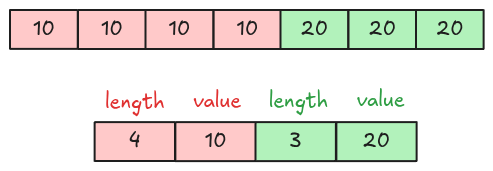
The Boolean Data section explains the bit-packed encoding. For RLE (Run Length Encoding), the data is encoded using 2 pieces of information: the run length and the repeated value. Below is an example of encoding 10, 10, 10, 10, 20, 20, 20.
RLE Bit-packing Hybrid Encoding
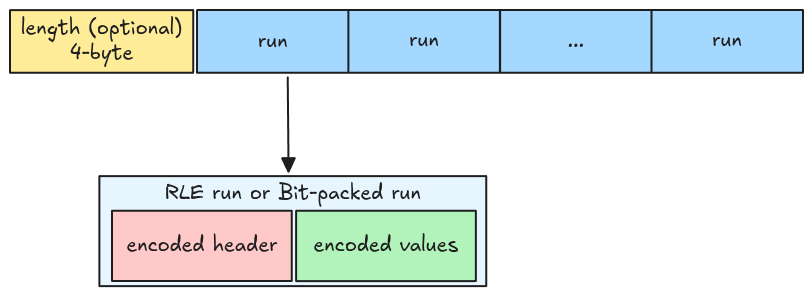
RLE Bit-packing Hybrid encoded data contains a 4-byte length and multiple encoded runs written back to back. A run can be either an RLE run or a bit-packed run, and contains two parts: a run header and the encoded values (both are themselves encoded!).
Implementation
For a rough implementation, we start by decoding an individual run header, then extracting all the runs, and finally decoding all of them.