Run
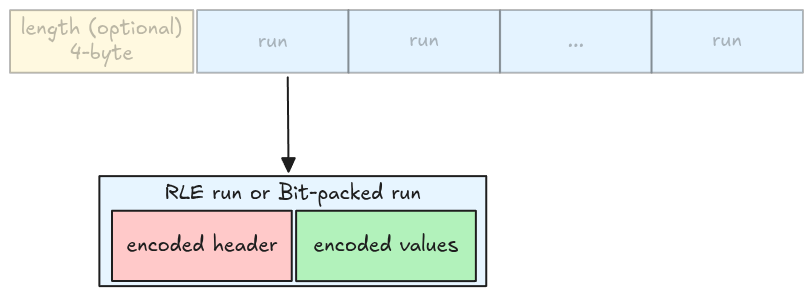
In this step, we will extract information for a single run, including a run header and its encoded values.
Run header
A run header is an integer containing 2 pieces of information:
- An indicator bit that tells us whether a run is an RLE run or a bit-packed run. This is stored in the LSB: 0 means RLE, 1 otherwise.
- The run length: determines how many values in the run. This is an integer represented using the remaining bits (without the LSB).
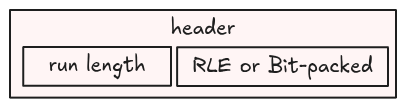
For example, if the run header is 13 (represented as 1101 in binary), then:
- LSB is 1, which is a bit-packed run
- Run length is 6 (
110in binary)
RLE run
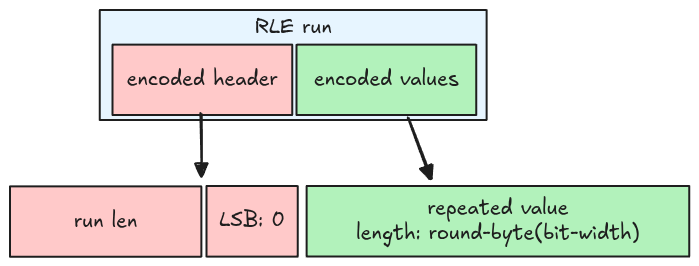
From the RLE encoding spec, an RLE run has some properties:
- The LSB is 0
- The RLE run length (the number of values) equals the run length information in the header
- The repeated value is stored in the encoded data, using the round up to the next byte bit-width. For example, if the bit-width is 1, then it needs 1 byte; if the bit-width is 9, then it needs 2 bytes.
Bit-packed run
For a bit-packed run:
- The LSB is 1
- The bit-packed run length (the number of values) is the header’s run length multiplied by 8.
- The values are encoded using bit-packed encoding, the total bits needed is the bit-width multiplied by the number of values.
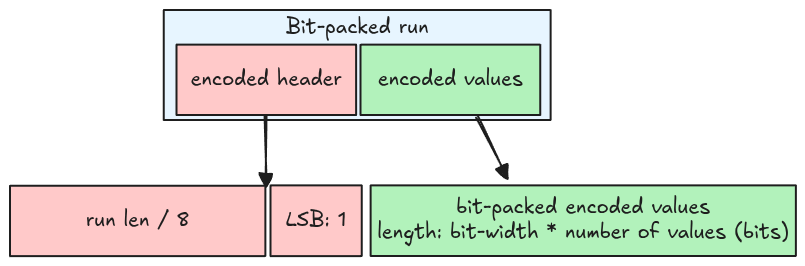
A bit-packed run stores a multiple of 8 values at a time, thus it might contain garbage. For example, if the bit-width is 1, and the number of values is 2, then the run stores 8 values (run length is 8), of which 6 are garbage.
Code representation
A run is represented using an enum RleBitPackedRun. All members are the same as introduced in the
above sections.
pub enum RleBitPackedRun {
    Rle {
        run_len: usize,
        bit_width: u8,
        encoded_values: Bytes,
    },
    BitPacked {
        run_len: usize,
        bit_width: u8,
        encoded_values: Bytes,
    },
}
Task
Implement the read_rle_bit_packed_run function in src/decoder/rle_bit_packing_hybrid.rs. It
takes the encoded page data (the packed multiple runs data) as Bytes, and returns a correct run
with the remaining bytes.
pub fn read_rle_bit_packed_run(
    encoded_data: Bytes,
    bit_width: u8,
) -> Result<(RleBitPackedRun, Bytes)> {
    todo!("step10-02: extract a single run")
}
Note that you only need to extract the encoded values in bytes, not decoding it.
Test
Test case for this step is step10_02_run.
Hints and Solution
Hint (how to decode the header)
Use uleb128_decode function to extract the header.
Hint (how to extract LSB and the run length)
let lsb = header & 1;
let length = header >> 1;
Hint (how to extract RLE repeated value)
Calculate the bytes needed for the repeated value using the provided bit-width, then use this value to extract the repeated value.
let needed_bytes = bit_width.div_ceil(8);Hint (how to extract bit-packed values)
Get the number of bytes needed for the run, then use this value to extract the encoded values.
let needed_bytes = run_len * bit_width / 8;Solution
pub fn read_rle_bit_packed_run(
    encoded_data: Bytes,
    bit_width: u8,
) -> Result<(RleBitPackedRun, Bytes)> {
    let (header, mut remaining) = uleb128_decode(encoded_data)?;
    let lsb = header & 1;
    let length = (header >> 1) as usize;

    let run = if lsb == 0 {
        let needed_bytes = bit_width.div_ceil(8) as usize;
        let encoded_values = remaining.split_to(needed_bytes);

        RleBitPackedRun::Rle {
            run_len: length,
            bit_width,
            encoded_values,
        }
    } else {
        let run_len = length * 8;
        let needed_bytes = run_len * bit_width as usize / 8;
        let encoded_values = remaining.split_to(needed_bytes);

        RleBitPackedRun::BitPacked {
            run_len,
            bit_width,
            encoded_values,
        }
    };

    Ok((run, remaining))
}